
Decahydron has developed a new technology for storing CO₂ in ultramafic rock. It injects the CO₂ as a dense, supercritical fluid, with no water added. It replaces the older method, which first dissolves the CO₂ in large volumes of water and then injects the carbonated water.
Both methods turn CO₂ into carbonate rock for good. The difference is how much CO₂ each well can carry. We compared the two in the same rock, with the same pressure limits and the same costs: the new technology needs a fraction of the wells and no water at all.
The chemistry: the same for both
CO2 + H2O → H2CO3 → H+ + HCO3−The water turns acidic.Mg2SiO4 + 4H+ → 2Mg2+ + H4SiO4Olivine, pyroxene and serpentine release magnesium, calcium and iron.Mg2+ + HCO3− → MgCO3 + H+Magnesite and calcite fill fractures and pores.0.4–0.6 t CO2 per t of rock reactedSolid carbonate: permanent, nothing left to leak.The two methods: how the CO₂ reaches the rock
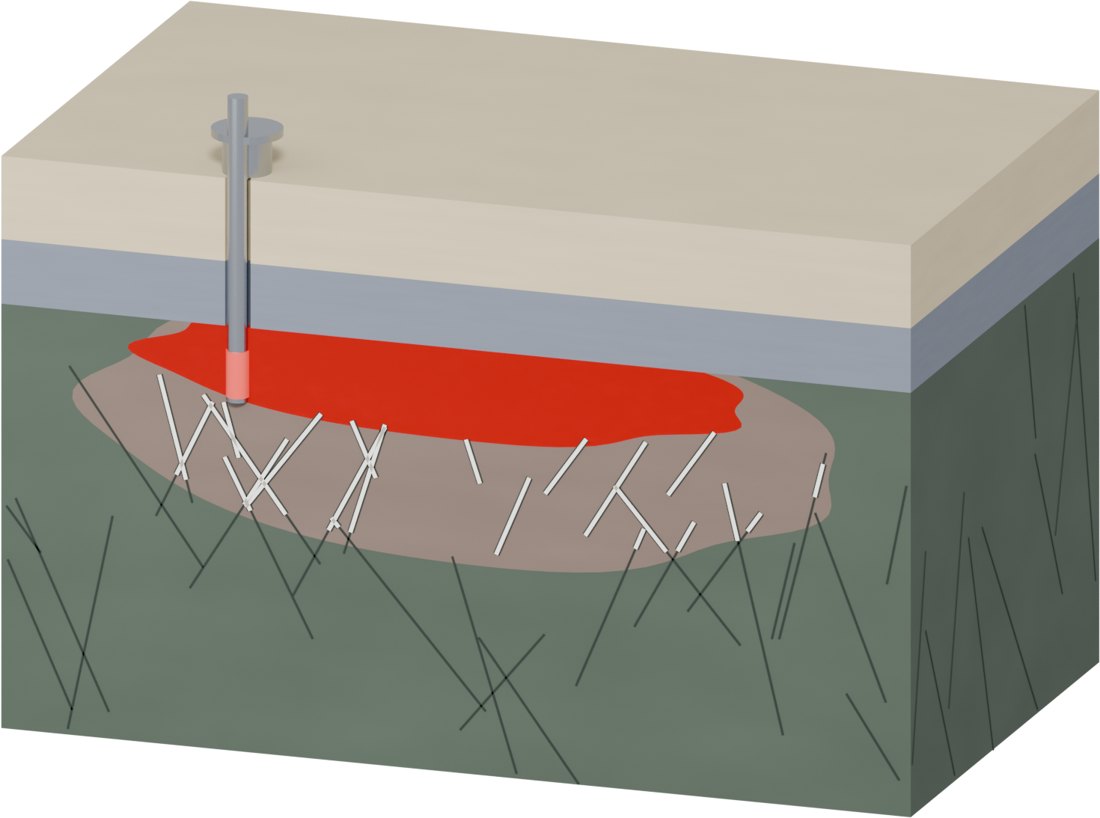
ADecahydron’s technology: dense CO₂, no water
 12345
- Wellhead: dense CO₂ at about 100 bar
- Cap rock holds the CO₂ in place
- Dense CO₂ spreads under the cap
- It dissolves into the water already in the rock
- and turns into carbonate in the fractures
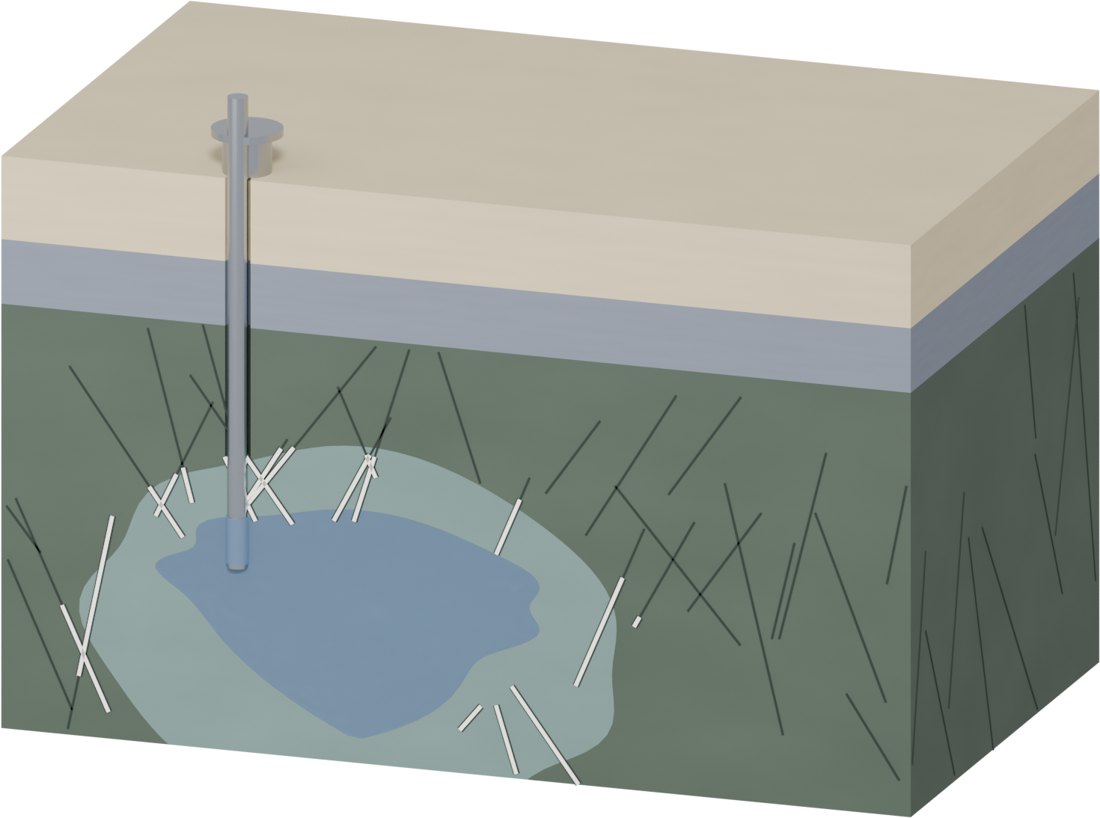
BThe older method: CO₂ dissolved in water
 12345
- Wellhead: CO₂ dissolved in water at 25-33 bar
- No cap rock needed: no free CO₂
- Carbonated water is denser, it sinks
- The acidic water dissolves the rock
- and the CO₂ turns into carbonate
Illustration Both routes end in the same carbonate. They differ in how the CO₂ reaches the rock.
One million tonnes a year: the numbers side by side
Why one well does the work of hundreds
Two properties set the gap. Dense CO₂ flows through the rock eight times more easily than water. And every tonne injected is CO₂, while carbonated water carries only 2.4% CO₂: the other 97.6% is water. Together, at the same pressure and in the same fractures, one well takes about 240 times more CO₂ as a dense fluid. Even if two-phase flow cuts the CO₂ rate by 70%, the gap is still about 70 times.
The water bill: 36 to 45 tonnes for every tonne of CO₂
CO₂ dissolves less in warm water and in salty water. At the Gulf’s 32 °C and a 25 bar dissolution pressure, one tonne of CO₂ needs 36 tonnes of fresh water, 41 tonnes of seawater or 45 tonnes of desalination brine. Higher pressure helps, but a million tonnes of CO₂ a year still means moving 25 to 45 million tonnes of water.
Energy is not what separates them
Dense CO₂ must be compressed to about 100 bar. Carbonated water needs less compression but has to pump forty tonnes of water for every tonne of CO₂. Taken from a pipeline, dense CO₂ uses less energy per tonne than the dissolved route; even from the capture plant the two are within a third of each other.
Wells decide the cost
To store a million tonnes of CO₂ a year, dense CO₂ needs about 4 wells. Dissolved in water, the same CO₂ needs about 644, because the water takes up almost all of each well’s injection capacity.
Fewer wells means a lower cost. The chart below shows relative cost: the typical cost of dense CO₂ is set to 1. The older method typically costs 66 times more. Even its cheapest cases cost more than six times the most expensive cases for dense CO₂.
Where each route belongs
Dissolving CO₂ in water is chemically sound and mineralises fast. It is the right tool in some rocks. In buried, capped ultramafic rock, dense CO₂ does the same job with a fraction of the wells.
- Buried ultramafic rock under a cap
- Rock with millidarcy-range permeability, as measured in the ophiolite
- Millions of tonnes a year from a handful of wells
- No water to source, pump or dispose of
- Shallow or outcropping rock with no cap to hold a dense phase
- Very permeable rock, far above what ophiolites offer
- Abundant water next to the site
- Pilots and small volumes
How we compared them. Steady radial flow into a 100 m interval at a pressure 3 MPa above the formation, the window a cap rock allows. Permeability from fall-off tests in our Sharjah well and from published injection data in the same type of peridotite. Dense CO₂ at 712 kg/m³ and 0.059 mPa s; carbonated seawater at 0.50 mPa s, carrying 1 t of CO₂ per 40.8 t of water. Solubility from PHREEQC (Pitzer database); compression and pumping energy from DWSIM process models; electricity at US$0.10/kWh. Costs cover injection only: site compression, water handling, injection wells and energy. Capture, transport and monitoring are the same for both routes and left out. Monte Carlo: 20,000 draws per route on permeability, interval height, pressure window, skin, two-phase losses, clogging and well cost, for one million tonnes of CO₂ a year delivered by a 30 bar pipeline.
Storing CO₂ in ultramafic rock?
If you inject carbonated water today, talk to us about what dense CO₂ could do in the same rock, with the same chemistry and far fewer wells.
Talk to us